
Introduction
The cryptocurrency industry is growing rapidly, bringing new opportunities for investors, traders, businesses, and online gaming enthusiasts. However, as digital assets become more popular, governments and financial regulators are introducing stricter rules to make crypto transactions safer. One of the most important topics in this changing environment is KYC Crypto News.
KYC stands for Know Your Customer. It refers to the process through which financial companies verify the identities of their customers. Cryptocurrency exchanges, digital payment providers, and other financial platforms use identity verification to reduce fraud, money laundering, and other illegal activities.
Today, KYC Crypto News is becoming an important topic for anyone interested in Bitcoin, Ethereum, stablecoins, crypto exchanges, and blockchain technology. Regulatory changes can influence how people purchase, sell, transfer, and store digital currencies.
At AskSlotBonus.com, we believe understanding cryptocurrency regulations is essential before using any crypto-related service. This guide explains the latest regulatory developments, identity verification requirements, privacy concerns, and what users should expect in the future.

Here is an SEO-friendly CTA and promotional section for your KYC Crypto News article on AskSlotBonus.com.
1. Promotional CTA box
🔐 Stay Updated with the Latest KYC Crypto News!
Want to understand the latest cryptocurrency regulations, KYC verification requirements, and crypto privacy updates?
Explore AskSlotBonus.com for informative crypto guides, online casino reviews, Bitcoin payment information, and the latest insights into KYC and No-KYC platforms.
Stay informed, understand the risks, and make smarter decisions before choosing any crypto-related platform.
Visit AskSlotBonus.com Today!
[Explore Crypto Guides] – Learn more about cryptocurrency, verification, and online casino security.
2. Promotional content
Discover More with AskSlotBonus.com
Cryptocurrency regulations are constantly evolving, making it important to stay informed about identity verification, digital asset security, and online payment methods.
At AskSlotBonus.com, we aim to make crypto and online casino information easier to understand. Explore our educational resources covering Bitcoin, crypto casinos, KYC requirements, No-KYC platforms, casino bonuses, and online gaming guides.
Whether you are new to cryptocurrency or an experienced crypto enthusiast, our guides can help you understand important features, platform policies, and potential risks.
Visit AskSlotBonus.com and stay informed about the changing world of cryptocurrency!
Disclaimer: Content is provided for informational and educational purposes only. Always check local laws, platform licensing, eligibility requirements, and terms before using any cryptocurrency or online gambling service. Gambling involves financial risk. Only participate where legal and never gamble more than you can afford to lose.
3. Suggested CTA button text
- Explore KYC Crypto News
- Read Crypto Guides
- Discover Crypto Casino Guides
- Learn About No-KYC Platforms
Recommended placement: Add the promotional CTA after the introduction or before the conclusion, and place the second promotional section near the end of the article.

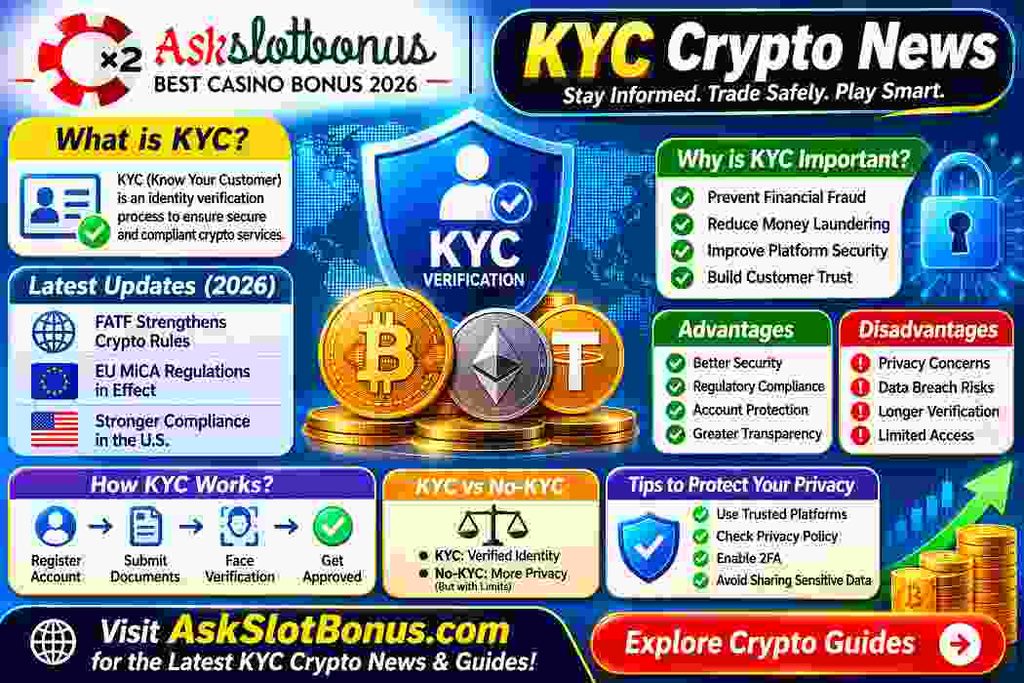
What Is KYC in Cryptocurrency?
Know Your Customer is an identity verification procedure used by financial institutions and cryptocurrency service providers. Its primary purpose is to confirm that customers are genuine individuals and that their financial activities comply with applicable regulations.
Traditional banks have used KYC procedures for many years. Cryptocurrency exchanges have increasingly adopted similar systems as governments introduce regulations for digital assets.
A typical crypto KYC process may require:
- Government-issued identification, such as a passport or driving licence.
- Proof of residential address.
- Personal information, including full name and date of birth.
- A selfie or facial verification.
- Additional documents for enhanced verification when necessary.
Not every platform requires identical information. Requirements depend on the service, jurisdiction, transaction activity, and applicable laws.
Following KYC Crypto News helps users understand why exchanges request personal information and how these requirements affect cryptocurrency services.
Latest KYC Crypto News and Regulatory Developments in 2026
Cryptocurrency regulations continue to evolve worldwide. Governments are working to establish clearer rules for digital asset companies while addressing financial crime and protecting consumers.
Here are some important developments influencing the crypto industry.
1. FATF Continues to Strengthen Crypto Compliance
The Financial Action Task Force (FATF) plays an important role in developing international standards against money laundering and terrorist financing.
Its July 2026 update on virtual assets highlighted progress in implementing the Travel Rule. According to FATF, 83% of surveyed jurisdictions had passed legislation implementing the rule, while additional jurisdictions were still working on implementation.
The Travel Rule generally requires relevant financial service providers to share specified originator and beneficiary information for qualifying transactions.
This development is important because cryptocurrency transactions can cross international borders within minutes.
For investors and traders, these changes mean that regulated crypto platforms may request additional information when processing certain transfers.
2. European Union MiCA Regulations
The European Union’s Markets in Crypto-Assets Regulation (MiCA) establishes a common regulatory framework for many crypto-asset activities.
MiCA introduces requirements relating to authorisation, transparency, disclosures, and supervision of crypto-asset service providers.
These regulations are particularly important for cryptocurrency exchanges operating in European markets.
The European Securities and Markets Authority (ESMA) maintains information about authorised crypto-asset service providers and other MiCA-related records.
Users following KYC Crypto News should understand that regulatory authorisation and customer identity verification are related but separate matters. A platform’s regulatory status should always be checked independently.
3. Stronger Compliance in the United States
The United States continues developing its cryptocurrency regulatory framework.
The GENIUS Act, signed into law in July 2025, establishes a federal framework for payment stablecoin issuers. Its requirements include provisions concerning financial crime prevention and customer identification.
These developments demonstrate that stablecoin services are also becoming part of the broader financial compliance environment.
For crypto users, regulatory changes can influence which services are available, how platforms verify customers, and what information they request.
Why Is KYC Important for Crypto Exchanges?
Cryptocurrency exchanges allow users to purchase, sell, and exchange digital assets. Because these platforms handle financial transactions, identity verification can play an important role in their security systems.
There are several reasons why KYC is important.
Preventing Financial Fraud
Identity verification helps exchanges identify suspicious accounts and reduce certain types of fraudulent activity.
For example, criminals may attempt to use stolen identities or fake accounts to access financial services. KYC checks can help platforms identify potential risks.
Reducing Money Laundering
Anti-Money Laundering (AML) procedures are designed to prevent criminals from disguising illegally obtained money.
Crypto service providers may monitor transactions and investigate unusual activity according to applicable laws.
Improving Platform Security
KYC can make it more difficult for individuals to create multiple fraudulent accounts using false identities.
However, identity verification alone cannot guarantee that a platform is completely secure.
Building Customer Trust
Users may feel more confident using services that provide transparent compliance information, clear security policies, and appropriate customer support.
These are some of the reasons why KYC Crypto News remains relevant to both experienced cryptocurrency investors and beginners.
KYC vs No-KYC Crypto Platforms: Understanding the Difference
One of the most discussed subjects in the cryptocurrency community is the difference between KYC and No-KYC platforms.
Both terms describe different approaches to customer identity verification.
| Feature | KYC Platforms | No-KYC Platforms |
| Identity verification | Generally required | May not be required for certain services |
| Personal information | Collected | May be limited |
| Privacy | Depends on data policies | Potentially greater identity privacy |
| Transaction restrictions | Based on compliance and account limits | Depends on platform and applicable rules |
| Regulatory obligations | Subject to relevant requirements | May still have legal obligations |
A No-KYC label does not automatically mean a service is anonymous, legal everywhere, or free from compliance requirements.
Some services may request verification when transactions exceed certain limits or when suspicious activity is detected.
Users should also remember that public blockchain transactions are generally traceable. A wallet address does not necessarily reveal someone’s identity immediately, but blockchain analysis and other information can sometimes connect transactions to individuals.
Before choosing a cryptocurrency service, check its legal status, security practices, withdrawal conditions, and privacy policy.
How KYC Verification Works on Cryptocurrency Platforms
The verification process varies between exchanges and other digital asset providers. However, most regulated services follow a similar procedure.
Step 1: Account Registration
Users create an account by providing basic information, such as their email address and other requested details.
Step 2: Personal Information
The platform may request the user’s full legal name, date of birth, and residential address.
Step 3: Document Submission
Customers may need to upload an accepted government-issued identification document.
Step 4: Facial Verification
Some services use a selfie or live facial verification to compare the customer with their submitted identification.
Step 5: Verification Review
The platform reviews the submitted information and may request additional documents if necessary.
Step 6: Account Approval
Once verification is completed successfully, the customer may receive access to additional account features, depending on the platform’s terms.
Following KYC Crypto News can help users understand how these procedures are changing and what documents different services may require.
How KYC Regulations Affect Crypto Casino Users
Cryptocurrency is also widely discussed in the online casino industry. Some platforms support digital currencies such as Bitcoin, Ethereum, and other cryptocurrencies for deposits and withdrawals.
However, crypto payments do not automatically remove identity verification requirements.
Online casino operators may have separate licensing, age verification, responsible gambling, and AML obligations.
Depending on the operator and the player’s location, users may be asked to provide identification before depositing, withdrawing, or accessing particular services.
Before using a crypto casino, consider the following points:
- Check whether the casino is legally available in your jurisdiction.
- Review its licensing and regulatory information.
- Read its KYC and withdrawal policies.
- Understand minimum and maximum transaction limits.
- Check whether additional verification can be requested.
- Review responsible gambling policies.
At AskSlotBonus.com, we encourage readers to evaluate casino platforms carefully instead of choosing a service based only on its cryptocurrency payment options.
KYC Crypto News is particularly relevant to crypto casino users because regulatory developments can affect payment methods, account verification, and withdrawal procedures.
Advantages and Disadvantages of Crypto KYC
KYC verification has both benefits and potential drawbacks.
Advantages
1. Better Fraud Prevention: Identity checks can help identify suspicious accounts and reduce certain fraudulent activities.
2. Regulatory Compliance: Verification helps regulated financial businesses meet applicable legal obligations.
3. Account Protection: Identity information may assist with account recovery and certain security investigations.
4. Greater Transparency: Appropriate verification procedures can support responsible financial operations.
Disadvantages
1. Privacy Concerns: Customers may be uncomfortable sharing personal documents with online platforms.
2. Data Breach Risks: Personal information can become a target for cybercriminals if a company has weak security.
3. Longer Registration: Verification may take additional time, particularly when documents require manual review.
4. Limited Accessibility: People without accepted identification documents may experience difficulties accessing certain services.
These advantages and disadvantages explain why cryptocurrency identity verification remains a widely debated issue.
How to Protect Your Privacy During Crypto KYC Verification
Users should take precautions whenever submitting personal documents online.
Here are some practical recommendations:
- Use established platforms with transparent regulatory information.
- Check the official website address before submitting documents.
- Read the platform’s privacy and data retention policies.
- Enable two-factor authentication.
- Avoid sharing identification documents through unofficial communication channels.
- Never provide account passwords or recovery phrases to verification agents.
- Contact official customer support if a verification request appears suspicious.
Remember that legitimate verification should not require you to reveal your private wallet recovery phrase or password.
Privacy protection is becoming an increasingly important part of KYC Crypto News, particularly as cryptocurrency businesses collect more customer information.
The Future of KYC Crypto News
The future of cryptocurrency identity verification will likely involve more advanced technologies and stronger international cooperation.
Several developments deserve attention.
AI-Powered Identity Verification
Artificial intelligence can help service providers identify suspicious documents, detect unusual account activity, and improve verification procedures.
However, companies must also address false positives, deepfake technology, and the protection of personal information.
Digital Identity Solutions
Digital identity systems may make it easier for customers to prove certain personal details without repeatedly submitting the same documents to different service providers.
Privacy-focused identity solutions could become increasingly important in the coming years.
Improved International Compliance
International organisations and national regulators are continuing to work toward more consistent approaches to cryptocurrency oversight.
The FATF Travel Rule is one example of this effort.
Privacy and Compliance Balance
The cryptocurrency industry will continue debating how to prevent financial crime while protecting legitimate users’ privacy.
The future of KYC Crypto News will likely focus on finding a practical balance between these objectives.
Why Follow AskSlotBonus.com for Crypto Updates?
Understanding cryptocurrency regulations can be difficult, especially when laws and platform policies change across different countries.
AskSlotBonus.com aims to help readers explore cryptocurrency topics, online casino guides, payment methods, and important gaming-related information.
Readers can use our website to learn about:
- Cryptocurrency and blockchain basics.
- Bitcoin and other digital payment methods.
- Crypto casino guides and reviews.
- Online casino verification procedures.
- KYC and No-KYC platform differences.
- Cryptocurrency security and responsible gaming.
We believe informed users can make better decisions when they understand the risks, regulations, and terms associated with digital financial services.
For more educational content, explore the guides available on AskSlotBonus.com.
Conclusion
Cryptocurrency regulations are becoming increasingly important as digital assets enter mainstream financial markets. Identity verification, AML procedures, and international compliance standards are shaping how exchanges and other crypto-related businesses operate.
The latest KYC Crypto News highlights the importance of understanding regulatory developments, protecting personal information, and choosing trustworthy service providers.
Whether you are a Bitcoin investor, crypto trader, or online casino enthusiast, staying informed can help you understand changing verification requirements and potential risks.
At AskSlotBonus.com, our goal is to make cryptocurrency and online gaming information easier to understand. Always check local laws and platform requirements before using any crypto-related service.
Frequently Asked Questions (FAQs)
1. What does KYC mean in cryptocurrency?
KYC means Know Your Customer. It is an identity verification process used by cryptocurrency exchanges and financial service providers to confirm customer identities and support regulatory compliance.
2. Why is KYC important for crypto exchanges?
KYC helps crypto exchanges identify customers, manage financial crime risks, detect suspicious activity, and meet applicable regulatory requirements.
3. Is KYC mandatory for every cryptocurrency transaction?
No. Requirements depend on the country, service provider, type of transaction, and applicable regulations. Not every blockchain transaction involves a centralised service requiring identity verification.
4. What documents are required for crypto KYC?
Commonly requested documents include passports, national identity cards, driving licences, and proof of residential address. Some platforms also require facial verification.
5. What is the difference between KYC and No-KYC crypto exchanges?
KYC exchanges generally require customers to verify their identities. No-KYC services may offer certain features without routine identity checks, although legal obligations and additional verification requirements may still apply.
6. Can I use cryptocurrency without revealing my identity?
Some blockchain activities can be performed without directly submitting identification documents. However, public blockchain transactions are often traceable, and regulated service providers may require identity verification.
7. Does KYC affect crypto casino withdrawals?
Yes. Depending on the operator, licensing conditions, and local regulations, a casino may require identity verification before processing withdrawals or allowing certain account activities.
8. How can I stay updated with KYC Crypto News?
Follow official regulatory announcements, recognised cryptocurrency news publications, and educational websites such as AskSlotBonus.com. Always verify important regulatory information using primary sources.
9. Is sharing personal information during crypto KYC safe?
It depends on the service provider’s security practices. Use reputable platforms, verify official websites, review privacy policies, and avoid submitting documents through unofficial channels.
10. What is the future of cryptocurrency KYC?
The future may involve AI-powered verification, digital identity solutions, improved international compliance, and stronger privacy protection. The industry will continue balancing user privacy with financial security.
Related Posts