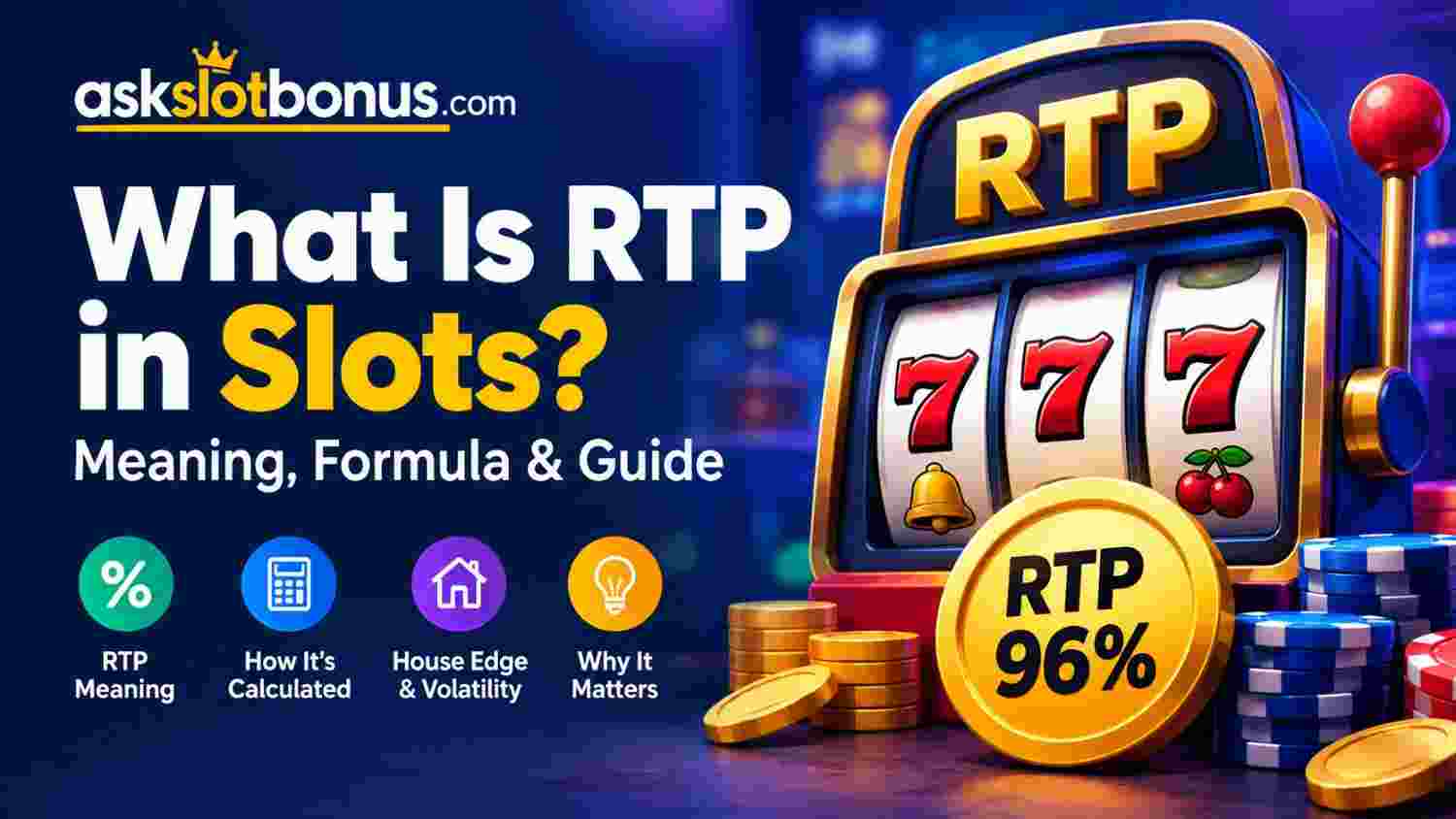
What Is RTP in Slots? A Complete Guide for Slot Players
If you have ever looked at the information for an online or land-based slot, you may have noticed a percentage labeled RTP. But what does it actually mean? Understanding what is RTP in slots can help players interpret slot-game information and understand how a game is mathematically designed to return money over a large number of spins.
In simple terms, RTP stands for Return to Player. It is a theoretical percentage that represents how much a slot is designed to return to players over a very large number of plays. For example, a slot with an RTP of 96% is theoretically designed to return $96 for every $100 wagered over an extremely large sample of spins.
Importantly, RTP does not mean that a player will receive 96% of their money back during a particular session. Individual results can vary significantly because every spin is independent and random.
What Does RTP Mean in Slots?
So, what is RTP in slots from a practical perspective? RTP is a long-term statistical measurement used to describe a slot’s theoretical payout percentage.
Suppose a game has an RTP of 95%. Over a sufficiently large number of wagers, the mathematical model of the game is designed to return approximately $95 for every $100 wagered. The remaining $5 represents the theoretical house edge.
This calculation is based on an enormous number of spins rather than one player’s short-term experience. A player could win substantially more than the theoretical return, break even, or lose their entire bankroll during a particular session.
Because of this, RTP should be viewed as a mathematical characteristic of the game rather than a promise of winnings.
How Is Slot RTP Calculated?
Slot developers determine RTP through the game’s mathematical model. The model considers the possible symbols, winning combinations, paylines, bonus features, and their respective probabilities.
A simplified way to express RTP is:
RTP = Expected player return ÷ Total amount wagered × 100
For example, imagine a hypothetical slot with an RTP of 96%. If players collectively wager $1 million over a very large number of spins, the theoretical return would be approximately $960,000.
The theoretical house edge would therefore be 4%.
However, actual results can differ from the theoretical figure, especially over smaller samples. This is why a player’s results over 100 or 1,000 spins cannot be expected to match the published RTP exactly.
RTP and the House Edge
RTP and house edge are closely connected.
If a slot has an RTP of 96%, its theoretical house edge is 4%. A game with 94% RTP has a theoretical house edge of 6%.
This does not mean the casino takes a fixed percentage from every individual player’s session. Instead, the house edge represents the mathematical advantage built into the game’s design over a very large number of wagers.
Understanding this relationship can make it easier to compare the mathematical characteristics of different slots without assuming that a higher RTP guarantees a win.
Does Higher RTP Mean Better Results?
When asking what is RTP in slots, it is also important to understand what RTP does not tell you.
A higher RTP does not guarantee that you will win more money during a particular session. For example, a 97% RTP slot can produce a losing session, while a player could win a large amount on a slot with a lower theoretical RTP.
One reason is volatility. Volatility describes how frequently and how dramatically a slot tends to pay.
A high-volatility slot may produce larger but less frequent wins, while a low-volatility game may offer smaller wins more frequently. Two games can therefore have similar RTP percentages while producing very different playing experiences.
RTP vs. Volatility
RTP and volatility are different measurements.
RTP describes the theoretical long-term percentage returned to players.
Volatility describes the distribution and frequency of potential wins.
For example, consider two hypothetical slots that both have 96% RTP. One might feature frequent small payouts, while the other could provide relatively rare but potentially larger payouts.
Therefore, looking only at RTP does not provide a complete picture of a slot’s mathematical design.
Players researching slot games through resources such as askslotbonus.com may encounter both RTP and volatility information. Understanding the difference between these terms makes such information easier to interpret.
Does RTP Apply to Every Spin?
No. RTP is not applied to each individual spin.
Each spin is determined by the game’s random-number-generation system. A winning or losing result on one spin does not cause the next spin to compensate for it.
For instance, if a player experiences a long losing streak, that does not mean a winning spin is automatically “due.” Likewise, winning several spins in a row does not mean the machine must stop paying.
This is an important concept because RTP describes long-term statistical behavior, not a short-term prediction.
Where Can You Find a Slot’s RTP?
RTP information is often available in the game’s help menu, paytable, rules, or information section. Online casino game descriptions may also list the percentage.
However, RTP can sometimes vary between different versions or configurations of the same game. Some games may also have different RTP settings depending on the operator or jurisdiction.
For that reason, players should check the specific version of a game rather than assuming that every version has exactly the same RTP.
Why Understanding RTP Matters
Knowing what is RTP in slots gives players useful information about the mathematical structure of a game.
It can help you:
- Understand a slot’s theoretical long-term return.
- Compare the published mathematical characteristics of different games.
- Distinguish RTP from volatility.
- Avoid treating short-term results as evidence of a guaranteed pattern.
- Read casino and game information more accurately.
RTP should therefore be treated as informational data, not as a prediction of what will happen during your next spin.
Best RTP Slots Casino Sites
Final Thoughts
So, what is RTP in slots? RTP, or Return to Player, is a theoretical percentage showing how much a slot is mathematically designed to return to players over a very large number of wagers.
A 96% RTP means that, theoretically, the game returns $96 for every $100 wagered over a sufficiently large sample. It does not mean an individual player will receive exactly 96% back, and it does not guarantee a profit.
RTP is also only one part of understanding a slot. Volatility, game mechanics, bonus features, and wagering conditions can all affect the playing experience. By understanding these concepts and checking the specific game’s published information, players can make more informed decisions about the games they choose to play.
FAQ
1. What is RTP in slots?
RTP means Return to Player. It is the theoretical percentage of wagers a slot is designed to return to players over a very large number of spins.
2. Is a 96% RTP slot guaranteed to return 96% of my money?
No. RTP is a long-term statistical measurement and does not guarantee any particular result for an individual player or session.
3. Is higher RTP always better?
A higher RTP represents a higher theoretical long-term return, but it does not guarantee better short-term results. Volatility and other game characteristics also matter.
4. What is the difference between RTP and house edge?
They are complementary measurements. For example, a 96% RTP corresponds to a theoretical 4% house edge
5. Can RTP change between casinos?
In some cases, different versions or configurations of a game can have different RTP settings. Checking the specific game’s information is therefore important.
Related Posts